Whether you’re prepping for the newest release or streaming for an audience of fans, adequate VRAM is essential. The amount of VRAM you have will affect the performance of the games you play or stream. Let’s take a look at what VRAM is, how it impacts computer performance, and how to check your graphics card’s VRAM capacity.
Table of Contents
What is VRAM?
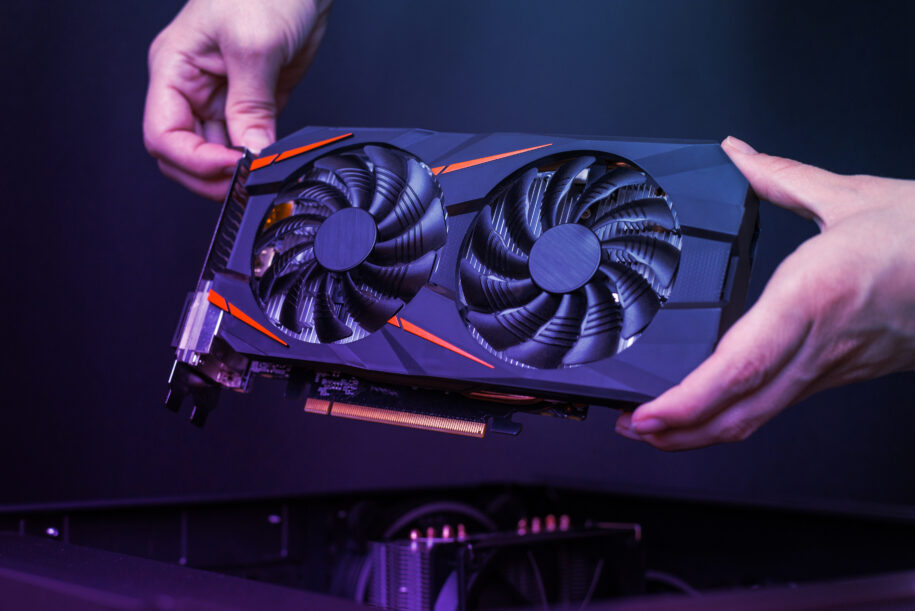
VRAM is memory used by a graphics processor to hold textures, frame buffers, and other rendering data. A dedicated graphics card normally has its own onboard VRAM. Integrated graphics usually use system RAM instead. These are different arrangements, so a shared-memory allowance in Windows should not be added to a graphics card’s VRAM specification.
How to Check VRAM on Windows
Windows includes tools for checking both graphics-memory capacity and current usage. Check the GPU name as well as the memory value, especially on a laptop or desktop with both integrated and dedicated graphics.
The two methods below show adapter information. For live usage, open Task Manager with Ctrl + Shift + Esc, select Performance, then select the GPU you want to inspect. Microsoft distinguishes dedicated GPU memory from shared GPU memory; the combined total is not the amount of physical VRAM on the card.
Method 1: Display Settings
- Right-click on the desktop and select ‘Display Settings’ from the drop-down menu. This will open the Settings app.
- Scroll down and click on ‘Advanced display settings’.
- Select the relevant display, then open its Display adapter properties. Check the adapter name: the GPU driving that display may differ from the GPU used to render a game.
- Under Adapter, look for Dedicated Video Memory. On a dedicated graphics card, this reports its dedicated memory. Integrated graphics can report a small reserved or compatibility value while using system RAM dynamically; this is not the full memory available to the integrated GPU.
Method 2: DirectX Diagnostic Tool
- Press Windows Key + R to open the Run dialog box.
- Type ‘dxdiag’ and hit Enter.
- Check the Display tab and, if present, additional Display or Render tabs. Match the GPU name to the adapter you want to inspect.
- Read Display Memory (VRAM) or Dedicated Memory for that adapter. Do not confuse it with Shared Memory or Approx. Total Memory, which can include system RAM.

How to Check VRAM on Linux
On Linux, use a tool supported by the installed graphics driver. The commands below inspect information; they do not increase VRAM. Identify the correct GPU first if the PC has more than one adapter.
Identify your graphics adapter
lspci | grep -Ei "VGA|3D|Display"
This lists display-related PCI devices when the pciutils package is installed. Use it to identify the GPU, then check its driver or manufacturer specifications. Hardware inventory fields and PCI memory address ranges are not a reliable substitute for a dedicated VRAM-capacity reading.
NVIDIA GPUs
nvidia-smi --query-gpu=name,memory.total,memory.used --format=csv
With a supported NVIDIA driver and utility installed, this lists each GPU’s name, total reported memory, and used memory. Read the units shown in the output. NVIDIA documents these query fields. If the command is unavailable or returns N/A, consult the driver documentation or the exact card’s specifications.
AMD GPUs using the amdgpu driver
grep . /sys/class/drm/card*/device/mem_info_vram_total
On systems where the amdgpu driver exposes this file, the output pairs a device path with its VRAM total in bytes. Divide by 1,073,741,824 to convert bytes to GiB. The Linux kernel documentation defines the memory counters; the similarly named visible-VRAM and GTT counters measure different things. On an integrated GPU, a reserved VRAM region does not describe the entire pool of shared system memory.
If none of these methods is supported, use the exact GPU model and its manufacturer’s specifications. A missing field or command is not evidence that the GPU has no memory.
How Much VRAM Do I Need for Games?
There is no single VRAM capacity that guarantees smooth gaming. Start with the publisher’s GPU requirements for the resolution, quality preset, and ray-tracing settings you want to use. Requirements for an optional high-resolution texture pack can be higher than those for the base game.
When a game exceeds the memory available to it, you may see texture-loading problems or uneven frame times. Those symptoms can have other causes too, so monitor memory usage and test a lower texture setting before assuming the GPU needs replacing.
Compare benchmarks for the exact graphics-card model and games you play. A card with more VRAM is not automatically faster than a card with less, and increasing capacity will not fix every game optimization issue. Keep the GPU’s processing performance, memory bandwidth, and target settings in the decision.
Does more VRAM mean better performance?
More VRAM helps when capacity is a limitation; otherwise, extra unused memory may not increase FPS. CPU performance, system RAM, storage, and the GPU itself also affect the result. Distinguish a memory-capacity problem from a graphics-processing limit before choosing an upgrade.
How Do I Increase My VRAM?
Dedicated graphics-card memory is normally fixed on the card. You cannot add a standard RAM module to increase it, and software settings do not create additional physical VRAM.
On a desktop with a replaceable graphics card, upgrading the GPU is the usual way to obtain more dedicated VRAM. Many laptops do not offer that option. For a desktop upgrade, check power, connector, and case requirements using our prebuilt PC upgrade guide.
For Integrated Graphics (e.g., Intel, AMD APUs)
Integrated graphics normally share system RAM. Intel explains that its graphics driver and Windows allocate memory according to workload. A larger shared-memory allowance is not equivalent to adding fast, dedicated graphics-card memory.
Some systems expose UMA frame-buffer or DVMT settings, while others manage them automatically. AMD recommends leaving UMA Frame Buffer Size on Auto for most desktop workloads. Reserving more RAM for graphics can reduce the amount available to other software and does not guarantee higher FPS.
Change a firmware memory setting only when your system manufacturer’s instructions or a specific compatibility issue calls for it. Adding system RAM may help if capacity is insufficient and the system supports an upgrade, but it does not turn an integrated GPU into a dedicated graphics card.
For Dedicated GPUs
If your computer has a dedicated GPU, check whether it can be replaced and which cards the system supports. Compare real game performance alongside VRAM capacity. For a desktop, verify case clearance, power-supply capacity, power connectors, and cooling before purchasing.
CyberPowerPC offers customizable systems with different graphics options. As a capacity example, NVIDIA specifies 32 GB of GDDR7 for the GeForce RTX 5090. Check the current configurator for availability and the exact specifications of the card you select.
VRAM Optimization Tips
These changes can reduce memory demand or help diagnose a problem without increasing the card’s physical VRAM:
- Lower texture quality or disable an optional high-resolution texture pack first when investigating a VRAM shortage.
- Reduce render resolution or demanding effects such as ray tracing, then compare image quality and frame times.
- Close unnecessary GPU-accelerated apps and monitor dedicated and shared memory usage during a repeatable game session.
- Install graphics-driver updates from your GPU or PC manufacturer and review the game’s release notes for fixes. Updates do not add physical VRAM.
You now have a way to check how much VRAM your GPU reports and distinguish it from shared system memory. Use that information alongside the game’s requirements and actual performance before deciding to upgrade.
Explore CyberPowerPC gaming PCs, AMD Radeon configurations, or NVIDIA GeForce configurations when you are ready to compare complete systems.